Text from this review not to be used without authorization.
Please contact:

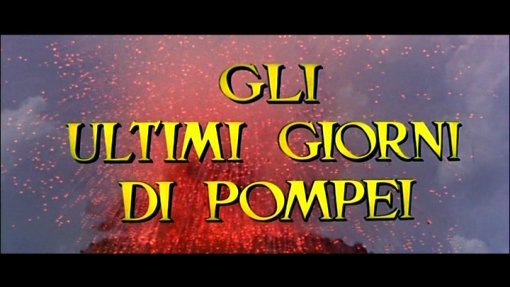
Returning to Pompeii after a spell in Palestine, the Roman centurion Glaucus (Steve Reeves) travels to his father's house, but discovers that it has been looted and his father murdered but a band of Christian Outlaws. During a city-wide festival, Glaucus takes out his anger by getting drunk and arrives at the city palace where he fights with one of the Praetorian Guards. Meanwhile one of Glacus' friends discovers a mask, identical to that worn by the Christian killers in the pocket of a drunk Roman soldier, but when another friend follow the soldier to see who he is working for, he winds up dead...
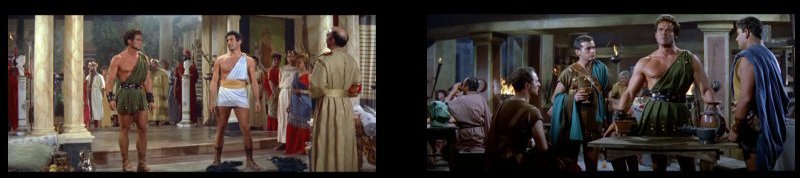
Although listing Edward George Bulwer-Lytton in the opening credits, this Italian production of the Pompeii story bears only a passing resemblance to the English author's The Last Days of Pompeii. Many of the main characters are present and named - notably Glaucus, Arbacès, Ione and Nydia - but the storylines around them are largely changed and many elements are left out. The team of five credited writers, including Sergio Leone, Sergio Corbucci and genre regular Duccio Tessari instead weave a new story around persecuted Christians, in what appears to be an attempt to cash in on the ever popular Biblical Epic market. Although hardly the most original topic, it is decently written and keeps the film moving well - there is some effective characterisation of the good guys but it does seem to miss out on quite a lot of detail, particularly surrounding the villains in the temple whose motives seem very implausible and whose methods seem unnecessarily complex. In keeping with the historical nature of the film, most of the film is taken up with dialogue with none of the strong-man displays that filled the Traditional Pepla (aside from a short fight scene between Glaucus and a guard). The destruction of the city is pretty grim stuff as the lead characters are pushed apart in the huge stampede and there is some genunine tension over who will survive.
Credited director Mario Bonnard was replaced by assistant director Sergio Leone after falling ill during the early days of the shoot. Unfortunately the direction on the film as a whole is rather generic and shows none of the genre defining talent he would display for Westerns - two key fight scenes noticably so, a punch-up between Glacus and Gallinus is rather routinely helmed and is further harmed by a lack of music, while Antonius' escape from the temple has the atmosphere more of a comedy sequence. Fortunately the city sets all look good, although strangely we never get any shots of the looming volcano until the film's climax. The arena sequence is a highlight with some good direction, editing and sets. The climax itself is certainly well staged using pyrotechnics to blow up bits of a hill, avoiding the normal volcano stock footage and the collapsing buildings look very effective with a minimum of model shots, however no reference is made to the recorded history of the eruption. The soundtrack by Angelo Francesco Lavagnino is quite generic but suits the film ably.

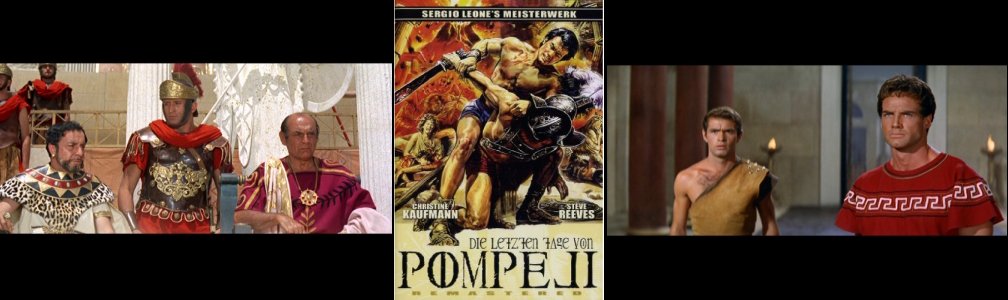
Steve Reeves is making his third Sword and Sandal movie and he proves that he can stand-up very well in an acting role that requires him to do more than just flex his muscles. After discovering the death of his father he appears angry, drunk and genuinely dislikable - one of his best scenes in his career. The respected Spanish character actor Ferdinando Rey was a few years away from making his name with Luis Buñuel when he appeared here, playing essentially the lead villain and giving a strong performance that manages to avoid the cartoonish excesses of many of the Traditional Pepla. The particularly attractive Christine Kaufmann, best known now as the one-time wife of Tony Curtis, gives a not particularly impressive performance as Ione although the limited script is largely to blame here. Barbara Caroll (Goliath contro i giganti (1961)) gives a strong performance as the blind Nydia, while fans of that later film should also recognise Ángel Aranda as the young Antonius. Mimmo Palmara was already a genre regular, having appeared in both Hercules films with Reeves, and gets to lay into him again here as the Praetorian guard Gallinus.
One of the first films of the Peplum boom, The Last Days of Pompeii seems to be following in the line of non-Biblical, Christian epics such as Demetrius and the Gladiators (1954) with the Pompeii setting a sidenote to excuse an explosive climax - something very similar to the way that Ernest B. Schoedsack handled the 1935 film of the same name. Sadly the script is less effective than that earlier film and although keeping the film moving, has too many problems to really satisfy. However some strong acting by Steve Reeves and a well helmed final reel climax make the film watchable and fans of Reeves and Pepla should find plenty to enjoy here.
| Anyone famous in it? |
Steve Reeves - the big American Peplum star who also starred in the epic Duel of the Titans (1961). Ferdinando Rey - Spanish born actor, best known for his work with Luis Buñuel, including Viridiana (1961) |
| Directed by anyone interesting? | Mario Bonnard - credited director, little known today despite having helmed over 50 films back to the silent era. Sergio Leone - believed to have directed most of the film, best known for Fistful of Dollars (1964) and its sequels. |
| Anyone else involved? | Sergio Corbucci is credited as writer and also assistant director, he worked on various Pepla but is best known for directing the revolutionary Spaghetti Western Django (1966). |
| Any gore or violence ? | Some light blood. |
| Any sex or nudity? | None |
| Who is it for? | Of interest to fans of Steve Reeves and Peplum/Epic films but not the best of the genre. |
|
Gli Ultimi giorni di Pompeii (1908) Gli Ultimi giorni di Pompeii (1913) Gli Ultimi giorni di Pompeii (1926) The Last Days of Pompeii (1935) Gli Ultimi giorni di Pompei (1950) The Last Days of Pompeii (1984 TV) |
The myriad of other film adaptations of the Pompeii legend. It was one of the most popular topics of early Italian cinema and was filmed several times during the silent movie era. It has only been filmed once as a Hollywood epic in 1935, although in 2007 Roman Polanski was attached to a new film project, based on a Robert Harris novel set in the city - although this project has not advanced any further. Although most of the other film versions credit it as an influence, the 1984 television film is the only version so far to have closely followed the original Edward George Bulwer-Lytton novel. |
| Visuals | Original Aspect Ratio - 2.35:1 anamorphic widescreen. Colour For most of the scenes the film looks very good with strong colours, light grain and no damage. A few short scenes are taken from a lower quality sources with some noticable grain or fading. |
| Audio | English and German. Both options available in original mono or remixed 5.1 or DTS. The English mono is the original audio and sounds strong with only a very slight hiss. The English remix tracks add newly created sound effects that are very effective during the explosive climax. All German tracks use the newly created sound effects. |
| Subtitles | None. |
| Extras | None. |
| Region | Region 2 (UK, Europe) - PAL |
| Availability | German release. DVD Title: Die Letzten Tage von Pompeji |
| Other regions? | This German release was available in a two-disc including the silent 1913 version of the film (with German intertitles) and a couple of short documentaries about Pompeii, this release is now out-of-print. The film is available on DVD from Italy with an identical print, English and Italian audio (with the remixed audio as well) and also includes alternate opening credits and a differently edited climax sequence as an extra, plus the Italian intertitled 1913 film. A US release is also available, but with a low quality fullscreen print. (Note: the 1913 version is available with English intertitles from Kino in the US) |
| Cuts? | The film is believed to be fully uncut. The print used is Italian. |